
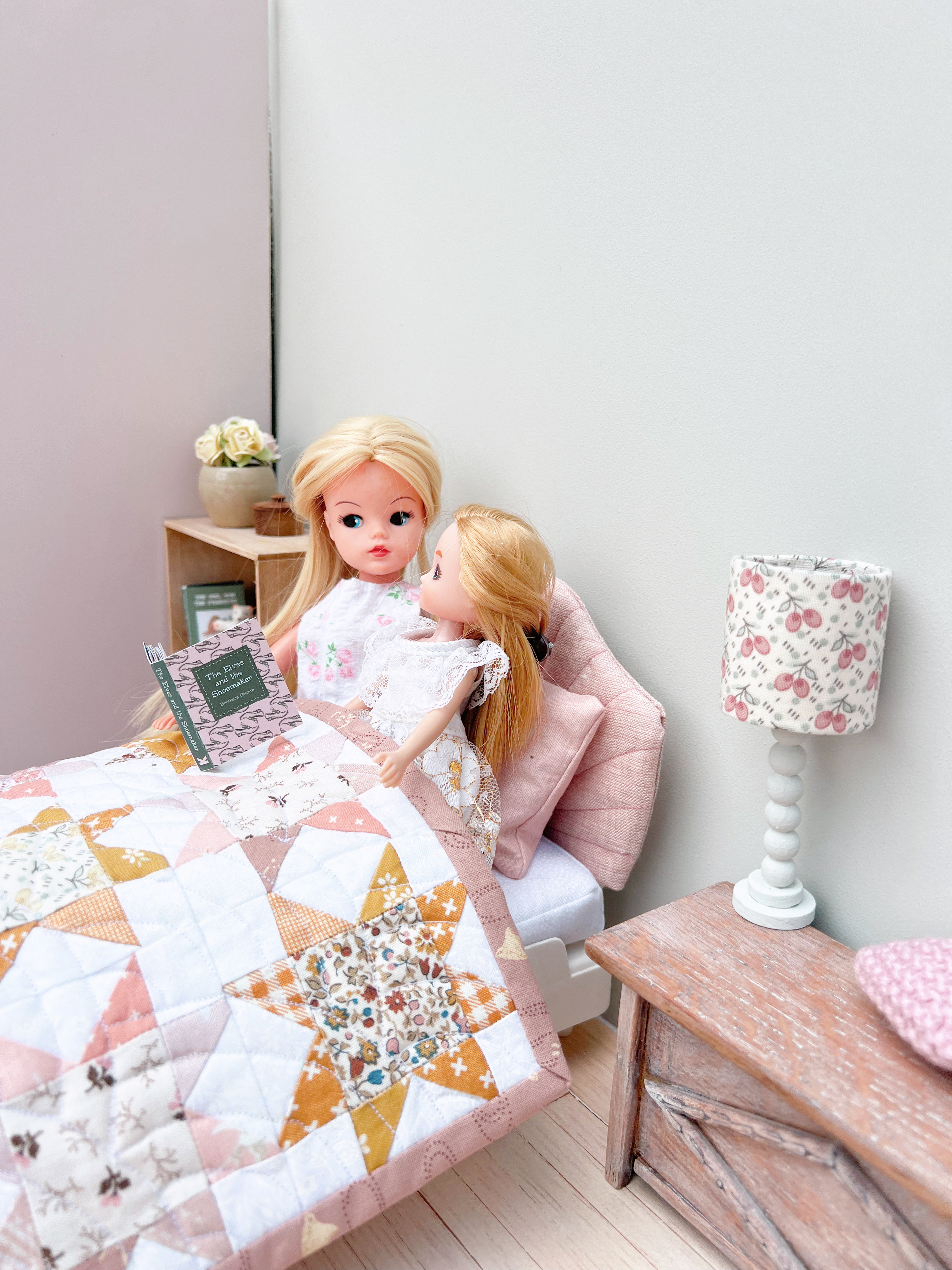
In this complete guide to sewing doll bedding I’ll teach you how to make a mattress cover, quilts and pillows for any size doll bed – from tiny dollshouse size to 18″ doll size and everything in between! Sewing doll bedding is the perfect way to practice sewing skills, learn new skills and use up unwanted fabric scraps in the process. You’ll find ideas suitable for complete beginners and those wanting to be more adventurous – so something for everyone!
How to sew a comfy doll mattress
Every doll, mouse and other loved soft toy needs a squishy comfy mattress on their bed to help them get plenty of rest. I searched far and wide for the best tutorials and then decided to do my own!
Supplies
- Fabric – size depends on your bed size. Quilting cotton works well for this type of project.
- Matching thread.
- Existing mattress or foam cut to size of bed frame or you can use toy stuffing.
- Sewing machine or hand sewing needles.
- Scissors for cutting fabric and snipping thread.
Time needed: 45 minutes
- Calculate fabric size
The mattress is made like a box cushion, with a rectangle for the top (A) and base (B) and four long thin rectangles for the sides – two long (C&D) and two short (E & F). Start by measuring your mattress size. Add a seam allowance of the same amount to all sides of each the rectangles. So if your mattress top measures 31.5 cm x 15.5 cm, this will become 33.5 x 17.5 cm with a 1 cm seam allowance added.

- Cut out fabric
Once you’ve calculated the size for each piece, cut out your rectangles.
- Sew the side pieces to the top
Pin side C to top A along the long edge, right sides together. Mark 1 cm (or whatever your seam allowance is) from each end. Sew in between your marks. Leaving this gap allows each strip to be joined without sewing over the previous one – pinning them back also helps (see picture below). Repeat with side pieces D, E and F.

- Make a box shape
Pin and sew the short edges at each corner together from the where it is sewn to the top piece, stopping 1 cm from end of seam (I forgot to do this – it didn’t matter too much!). Trim the corners.

- Attach the base
Repeat step 3 to sew the base (B) to the sides – but leave a short edge open. Trim the corners.

- Turn and stuff
Turn your mattress cover right side out and press the raw edges in by 1 cm. Put your mattress or foam piece into the cover. Pin the open side together and oversew closed by hand.

- Add dimples
I wasn’t sure what the little dips in a mattress are called, so I’ve called them dimples. Use a heat erasable marker to mark out six evenly spaced dots. Using a needle with doubled up thread, go from the base up through your marked dot (leaving a long tail) and back again. Pull both ends of thread tight and do a firm double knot or two. Trim the ends. Repeat for the remaining dimples.


The photo above is a dollhouse size bed frame with a small size mattress. I’ve also made a replacement mattress cover for a Sindy doll bed using the same method.

Other ways to make a mattress
There are other ways to make a mattress, but I found it was tricky to work out the right sizing. However, if you want to try another method then here are my suggestions:

An older post of mine – includes instructions for a dolls house bed as well as mattress and cushions
This tutorial from Joyberry Studios is for a larger doll cot size and uses a similar method to my doll house bed mattress (below).

This tutorial for a smaller size mattress is from Ann Wood Handmade and is similar but with squares cut from the corners to give the mattress shape. I love the vintage feel that the fabric gives it.

How to sew a lovely doll quilt
If I’m honest, making the mattress wasn’t my favourite part of this project! There is a limit to what you can do to make a mattress interesting and I had much more fun making the quilts. I used a technique called Foundation Paper Piecing (FPP). Now it’s important for you to know that I have not done any foundation paper piecing before and I’m still learning quilting – so if I can do it – then you should give it a go too! I made a mini-quilt for my Maileg dollhouse bed and a larger one for the Sindy bed.
Start by selecting some lovely pretty fabric scraps and a larger piece for the backing fabric and binding. You’ll also need some thin quilt wadding. You’ll then need to head over to Rosie Taylor Crafts and download the free templates for foundation paper piecing. I used the flying geese 1 1/2 x 3″ one for the Maileg mouse quilt and the 3″ sawtooth star for the Sindy bed quilt. As you know the finished size of each block, you can easily work out how many you will need to make a quilt of the right size for your doll bed. Rosie has done a sawtooth star tutorial on You Tube so you can see how the FPP method works. Once you’ve got your head around which way the fabric goes, then it’s relatively easy to sew. The nice thing is that using the paper template means that you can get accurate blocks at a small scale – which would be trickier if using traditional patchwork methods. She also has good videos on her Instagram. If you prefer written instructions rather than a video then have a look at this post from Amy Smart ‘Diary of a Quilter’.
This is some of my work in progress making the Sindy quilt:


Once you have made all of your quilt blocks, join them together with a 1/4″ seam, press seams open if you can. You’ll then need to make a quilt sandwich, quilt and then add binding. As I’m not an expert I’m once again sending you over to Amy Smart. She has done helpful posts for each step:
Beginner Basting and Quilting Tips covers everything you need to know about making a quilt sandwich and quilting it.
How to Finish a Quilt includes all the information you need on binding. I used a straight binding (rather than bias cut binding) and used smaller widths (under 2″) for both my quilts.
Here is some of my work in progress making the Sindy bed quilt:


This is what the final quilts look like on the doll beds:


How to sew a ‘faux’ doll quilt
If you don’t want to spend lots of time cutting up fabric and sewing it back together (I’m now hooked on patchwork, but I get that it’s not everyone’s bag or it may feel too tricky) then you can easily create a ‘faux’ doll quilt. To do this you’ll need to find some fabric with a small patchwork design on it. Here are a couple of examples that I have found (just waiting to be made up!):

You can follow the same techniques as above to baste you ‘quilt’ top to the wadding and backing, and then quilt and bind it. Or just make a simple duvet by sewing two rectangles together, leaving a gap. Then turn right side out and lightly stuff. Sew the gap shut by hand or machine.
Sewing doll pillows
To make a doll size pillow, work out the right size by measuring the width of your bed (divide by two if it’s a double bed) – the pillow width will be a touch smaller. Cut out two rectangles and sew around 3 1/2 sides (see the images here). I added a frill by gathering a strip of fabric and sandwiching it between the top and bottom of the pillow, facing inwards, before sewing the side seams. Turn right side out. Make sure you don’t over-stuff the pillows as you want your doll’s head to rest on them nicely. Hand sew the gap closed to finish. You can add embellishment with ribbon or lace.
More inspiration?
If you want lots more inspiration for doll bedding then have a look at my Pinterest board:
